martes, 15 de marzo de 2011

Cupping (more underqualified instruction at FEDEPMA)

A while ago, we taught a coffee preparation (barista, sort of) course at FEDEPMA. The goal was always to follow up the black coffee and espresso training with a cupping, which is basically a wine tasting, but for coffee. Last Thursday, we finally had the chance to lead FEDEPMA's first cupping.

Even though I'm writing this entry, Stacy deserves most of the credit for the cupping, and most photos that don't include her are hers too, save for the notably bad shots. Trust me, you'll see what I mean when you get to the second pic. Also, our friend Judith deserves a big thanks for sending cupping docs and suggestions from DC...


The cupping table at FEDEPMA.


For non-geeks, cupping is a great way to learn how to describe the flavors and other characteristics of coffee, and it's particularly helpful for someone preparing coffee in a coffeeshop or selling the beans to tourists. If you can say something more about a coffee besides that it tastes good, you can have greater confidence talking to customers. So one of the thoughts behind the cupping was that it will help FEDEPMA employees speak to tourists and future customers at their cafe (still not built).

More importantly, though, cupping can serve as a means of quality control. If a farmer or head of a processing facility cups frequently, he can notice changes in the quality of his beans, and if he or she finds a defect, he can search for the cause, and try to correct it. Hopefully, Pedro and the other coffee employees at FEDEPMA will keep cupping, and it will help them grow and process better, more consistent coffee.

Anyways, this is how we did it, photo essay style:

Figuring out the process

There's more than one way to cup a coffee. Professional cuppers score coffee on a scale of 1-100, and use a very detailed form to evaluate the coffee. The FEDEPMA employees are not professional cuppers, and neither are we. This weekend marks the first time that I needed more than one hand to count the number of times I've cupped coffee.

Stacy set about making our own, simplified cupping form, that would be a bit more useful for FEDEPMA. I helped a bit with the Spanish. As with the espresso and black coffee course, figuring out the best way to translate colloquial coffee talk was at times a bit challenging.


The FEDEPMA cupping form. Why didn't I just take a screenshot? Because that would have been the smart thing to do.

We were also a bit limited by our equipment, and went about a not-at-all rigorous trial and error effort to determine appropriate procedures and the correct ratio of coffee to water, considering FEDEPMA's limited supply of cups (we opted for cappuccino mugs).

The cabaña kitchen table is also the experimentation station.

Once we figured out the procedure, and wrote some great accompanying docs for the presentation, we led the cupping at FEDEPMA. What follows are a simplified version of the steps, leaving out the table setup part. Also, you're supposed to write something down every time you smell or taste, throughout the ordeal.

Los Pasos de la catacion

1. Measure out the coffee for each sample. Somewhere in the background, start heating water. The amount of coffee should be an exact weight. Since the scales at FEDEPMA are terrible, we used two very level tablespoons of whole beans, which I guess is around 12 grams. Important thing is that it's the same every time.

Two samples per person, check.

2. Grind those beans. Then smell them.

Ready for sniffing.


3. The water should be boiling by now. Take it off the stove, let it cool for 30 seconds, then slowly pour it into the cups, in the same order you ground the coffee. Then smell the coffee again.


Echando agua.

Wearing Ted King t-shirts makes you feel like a faster cyclist, fact. Even if that feeling is depressingly far from the truth...

Get in there.

Falling asleep in this position is not recommended.

4. A crust of wet coffee grounds will form on the top of the cup. After 3-4 min, break it with your spoon, pushing the grounds towards the bottom of the cup. Keep your nose close, smell the break.


Doña Loida has respecfully asked that you refer to her as Loida "THE CRUSTBREAKER" Margarita from this point forth.


5. Clean the excess grounds from the top of the cup. Two spoons work well for this.


Clean, I guess.


6. Taste the coffee. Don't take a sip from the cup - there are a lot of grounds at the bottom. Grab a spoonful, and slurp. Do this several times. Ponder the coffee's taste, aftertaste, brightness, and body.

La encargada del taller de catacion.


Juan tastes melon. Seriously, Juan couldn't stop talking about how the coffee tasted like melons.


Tasting, taking notes, keeping track of international coffee prices via text message. Pedro demonstrates proper multitasking technique.


The cup is for spitting.

7. Discuss. Compare your notes. You weren't supposed to be talking during the cupping, so now's your chance to share your observations. This is a great time to practice sounding like a pretentious coffee snob.


Comparing apuntes, and staring off into the distance. Lunch looms on the horizon.


The crustbreaker ponders. I think Pedro's making fun of her or me, but since he's speaking Tzutujil, I really have no clue.

Otto may be Guatemalan, but he gesticulates like an Italian.


somebody made a funny.

lots of adjectives.

Anyways, that's cupping at FEDEPMA. This week we're teaching the coffee prep course again. Today, while trying to figure out a way to heat up the water (kitchen space was occupied), we had two small gas leaks before finally settling on this:


Seriously, if that doesn't qualify as the most bushleague setup you've ever seen, please do share.

martes, 8 de marzo de 2011

massages... and get off the computer

We only have three weeks left in this magical place. I can't believe it. Time is always a friend and an enemy. Kevin and I have been pretty busy the past few days. We are giving a coffee cupping introduction course this week at FEDEPMA, and I've been working on editing text for different local websites (that hopefully will be launched in the next 5 years...)

We did manage to get a massage in- courtesy of the same Valentines Day gift to each other.

I think I really needed it because the massage therapist, Ada, firmly reminded me that my shoulders, neck and arms were very tense.


She said, "Tengas cuidado con tu postura."


Well, then I told her about our computer set-up... and all the other things we do daily down here that we just don't have much control over. Obviously, my posture has been affected from hunching over on the computer, washing dishes, washing clothes and walking around upstairs in our cabin (in which the ceilings are too low, even for Guatemalans). Needless to say, the massage was great, and reminded me that even when you think you're doing nothing- be careful- you might be hurting yourself.


Speaking of staying healthy, I've also launched a yoga blog for the space where I work. It's still in the early development stages, as I'm trying to become competent in other blog hosting sites (ps: we HATE blogger, ours truly). So after you strain your back and neck reading about the benefits of yoga on the computer, get up and do something good for yourself.

sábado, 26 de febrero de 2011

mountain biking in guatemala

So, way back in August, I decided to bring my mountain bike with me when I moved down to Guatemala. I'm somewhat embarrassed to admit this, but the decision was in part based on a story in Bike magazine that said Guatemala has some amazing riding. It does. But the Bike magazine writers toured the country with a guide the whole time, had a car to bring them wherever they wanted to go, and were able to find, and stick to, reasonably well established mountain bike trails.

I'm glad I brought the bike, and if I hadn't, I'd go insane living in a country with this landscape without any chance to explore, but needless to say, my experience has been a bit more frustrating than a magazine travel piece.

There have always been a few trails just down the road from our house - great singletrack, but it's just 25-30 min worth of riding, and every time I've gotten excited about a new trail I find back there, it dead ends. And finding other good trails to ride has been tough, particularly around the lake.


This is great. But it took less than 15 min to get here, and the trail ends in 200 ft.


One of the reasons it's tough to ride near the lake is that the slope down to the water is just too steep, and the trails have become heavily rutted by erosion. Nerd alert: the International Mountain Bike Association recommends following the rule of half when building trails. Trails should be no greater than half as steep as the fall line of the hill they occupy in order for water to run off properly. Trails here weren't built - they formed through years of farmers and animals walking to their fields, and Guatemalans tend to spit in the face of the rule of half, walking straight up the fall line.


Riding to the top of the ridge above the lake seems to be the recipe for good rides though, as the mountains beyond the Atitlan crater have a gentler slope and there are actually a few parks built for recreation, as opposed to trails just leading to a farmer's field. Still though, there are frustrations.


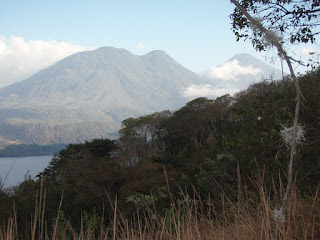
View from somewhere near Santa Clara.


hello.


First of all, to get to the top of that ridge you have to ascend about 2100 vertical feet, not including the half dozen smaller hills on the way to base of the main climb to Santa Clara. To get to the next ridge after Santa Clara (and the downhill through a park called ChuiraXamolo is awesome): another 1500 or so feet vertical. For me, all that climbing on the road is boring, and since I'm not in the best shape right now, it leaves my body pretty wasted for the fun part, the actual trail riding.


It's a bit hard to see the switchbacks on the road below, but this isn't even all the way up the climb. No fun.


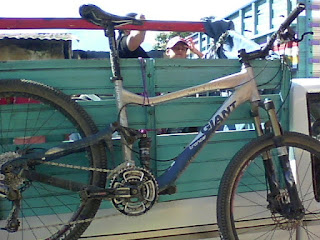
Lately, I've been resorting to what mountain bikers in the US call "shuttling," although in the U.S. that typically means having a buddy drive you to the top of a mountain so you can ride down. Here it means I tie my bike to the side of a pickup truck or the top of a minivan and hop in the back with 15-20 campesinos, who all think I look funny in my bike shoes. Even with the pickup, there's no such thing as a flat ride here, and I invariably have to do tons of climbing, so I don't feel too lazy.


Tied on with a piece of nylon cord. Safety first.


Terrible video of the pickup truck. In case you were wondering about Guatemalan public transportation.


Second, the U.S. has established trail networks, and Guatemala does not. My rides generally consist of spotting a promising-looking trail on the side of the road, and if it doesn't end in 100 yards, I ride for 10-20 minutes before popping out on a dirt road somewhere. Then repeat. Sometimes I get the chance to ask a Guatemalan if there's a sendero, no un carretera o camino (singletrack, not another dirt road, goddammit) that goes to X town or X road. They invariably do not understand why I would want to ride the bike on anything besides the road, but 1/10 of the time I get some good directions that lead 20 min of great riding.

Also, there are a lot of obstacles. Not like logs on the trails or rocks that make the riding difficult, but other things. Best kinda-crash I've ever had: rode headtube first into a rope. One end was attached to a fence, the other end to a cow. Both of us went away unscathed.

More often, the obstacles are just of the hike-a-bike variety. The hills here are super steep, so it's pretty frequent I have to shoulder the bike for at least a few minutes every ride, even in parks like Corazon del Bosque.


I am getting effing serious about practicing my shoulder carries for next cyclocross season! Gonna be the fastest guy in the B's up the run-up, and first to the beer handup.

Partway up the stairs in the Corazon del Bosque park. Five minutes later, got chased by 3 dogs.


That being said, even though it can be a bit frustrating, and I never get the chance to ride on trail for an uninterrupted hour or two, when the riding's good, it's great. It's an awesome way to see the country, and it feels great to ride on singletrack knowing that it's been a while since the trail's seen a bike. The downhill from ChuiraXamolo to Santa Clara is one of the most fun I've ever ridden - 20-30 minutes of mostly downhill ranging from technical singletrack to super-fast, but still mildly sketchy doubletrack. Here a few extra pics from the last couple of weeks (most media in this entry is from my ride on Saturday).


Partway down from ChuiraXamolo to Santa Clara. Not too shabby.

Taking the trail down > the road.


Some people think PowerBars are the mid-ride snack of choice. I strongly disagree. I hope they didn't give me that plate just because I'm a gringo.


In other, unrelated news, Stacy spent Sunday away from the house, hanging out with a friend across the lake in Panajachel. This was her welcome home present. She is not thrilled.


.